Roles
-
Level designer - upholding the narrative designer’s vision and creating opportunities for the invocation mechanic.
-
Mechanics designer - Spell invocations, world interactions and the companion NPC's behaviour.
-
Ran 3 playtest sessions, iterating design from feedback
-
Wrote & maintained Design documentation
-
Weekly client updates to present progress, answer questions & adjust with feedback.
Mechanics Design
-
Players cast 'Invocations' based off button sequences to direct Genhu, the golem companion. Design goals included:
-
Reinforce the pre-written narrative, using gameplay to draw players further in.
-
Reward via in-level exploration & input experimentation: All invocations are available but hidden.
-
Endear the golem NPC by tying it to the core game loop.
-


Mechanic Readability
-
Early designs attempted UI overlays but this was replaced with a more immersive combination of UI and in-game animation.
-
Gameplay was refined with internal and external playtesting. For example, playtesters had difficulty understanding the 'targeting' stage for some invocations e.g. 'Move Genhu'. This led to improvements in VFX and colour association to telegraph what players needed to complete the action.

Players cast 'Invocations' based off button sequences. These are found in-game or discoverable by player input. Early designs attempted UI overlays but this was replaced with a more immersive combination of UI and in-game animation.
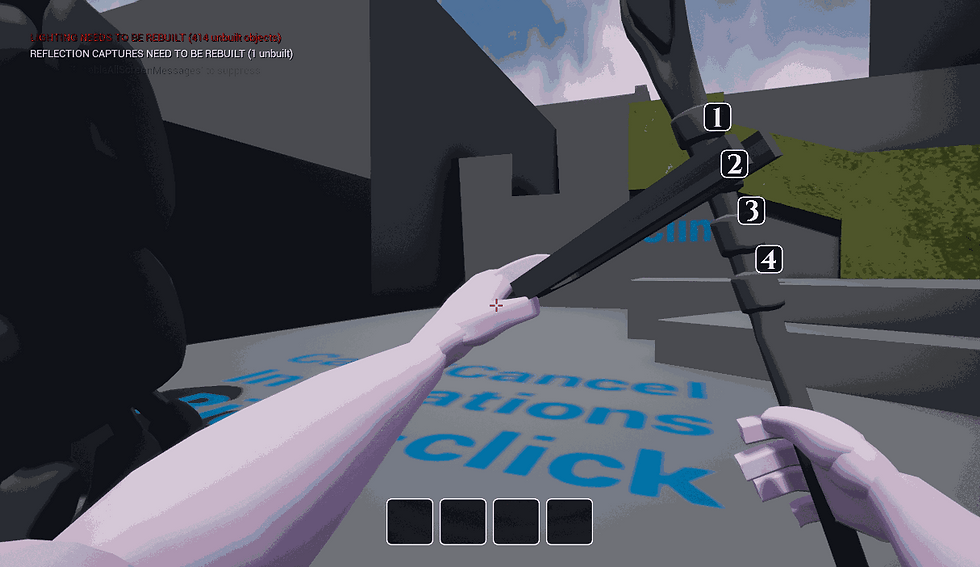
Early prototype for casting invocations and moving the NPC companion.

NPC companion could be used to traverse the level higher than players can jump.
Players cast 'Invocations' based off button sequences. These are found in-game or discoverable by player input. Early designs attempted UI overlays but this was replaced with a more immersive combination of UI and in-game animation.
Level Design
-
Level design aimed to highlight the Narrative Designer's script and problem-solve with the Invocations mechanic.
-
Built with combination of art team's assets, modular kits and Unreal's Landscaping tools.
-
Refined level to improve NPC companion's Navmesh pathing.

Progression of the game level from pre-vis -> greybox -> Alpha -> Gold stage

Progression of the game level from pre-vis -> greybox -> Alpha -> Gold stage
Controlling Player Focus
-
The game's level had limited space but was made to feel larger by the players' freedom to travel anywhere. Players were only limited by the invocations available which encouraged player exploration.
-
To guide the overall story I used tricks in the level design to draw players' eyes:
-
Vistas: Constructed views at key locations to guide attention
-
River: Marks a clear start-to-end path so players were never lost on the ultimate goal.
-
Light sources: Warm, 'man-made' fires contrasted the colder natural landscape
-


Playtesting
-
Ran 3 major playtests at MVP, Alpha and Beta stages.
-
Recorded quantitative & qualitative data using observations and pre-written questionnaires. Focused on narrative cohesion and mechanics' intuitiveness.
-
Identified patterns of feedback from the data and presented to all departments. Defined actionable tasks for next-stage iteration, marked with severity.
-
Example: Early playtesters noted motion sickness while climbing, which lead to changes in animation, camera and art assets.
-
Example: Improved 'targeting' indicators for casting invocation, signposting with improved VFX and colour association.

I categorised designer observations & playtest feedback into clear tasks for the projects' next iteration. These were marked by severity & urgency and tasked to team members.

This was testing players' memory of locations visiting during a playtest. It was combined with observational notes to confirm answers.
I categorised designer observations & playtest feedback into clear tasks for the projects' next iteration. These were marked by severity & urgency and tasked to team members.
Design Ownership
-
Wrote and maintained Down Current's Game Design Document, asset lists and other design materials.
-
The GDD covered player interactions, cross-platform controls, User Interfaces, level specifications and other technical information needed to develop the game.
-
Written to be understood in a cross-discipline team. Referenced by programmers, artists, designers and producer throughout the project.

